How many snacks can we offer our dogs during the day? It can often happen to give them a small reward after a well-executed “sit” or when we return from our walk. They may look like small things, but snacks are part of their daily diet too and should be considered in their daily ration.
This doesn’t mean you should eliminate treats, because they can be a precious help in their education and in our relationship. It means, rather, learning how to use them without excess. In this article, we will find out which snacks we should choose, how to calculate them in the dog’s daily food amount and what type to use depending on the occasion.
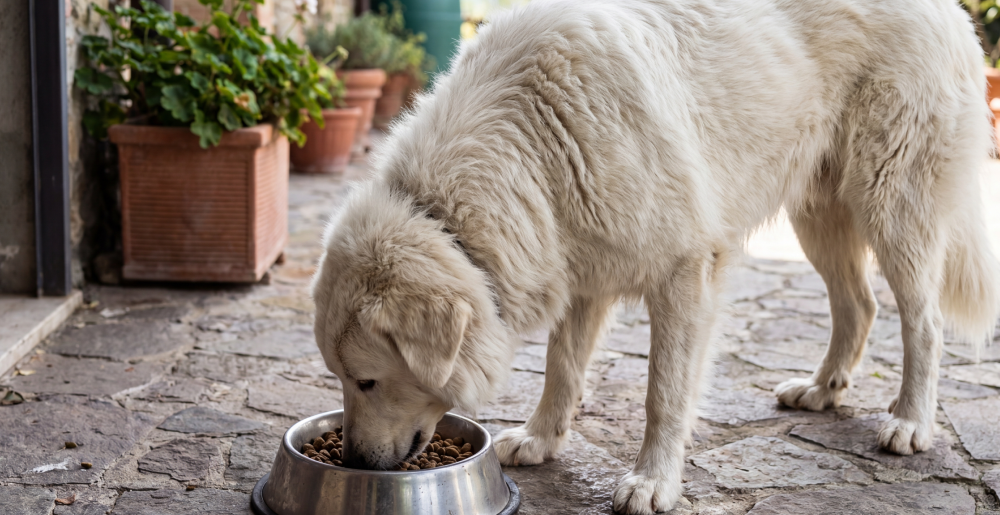
Snacks shouldn’t represent more than 10% of our dog’s calorie intake, while the remaining 90% should come from a complete food (for example, Original Formula or Monoprotein Formula kibbles) that is formulated to provide, in the correct quantities, all the nutrients to meet their daily requirements.
This rule is indicated in the World Small Animal Veterinary Association (WSAVA) to avoid all those small extras to modify the diet’s balance.
Let’s make an example. As explained in the article about how many kibbles we should feed our dog, for a small sized dog weighing 10kg with a medium activity level, the daily amount could be 135-160 grams of kibbles to be divided into multiple meals.
However, we can’t simply add biscuits or snacks to this quantity: each snack increases the overall caloric intake of the day. Further help with quantities also comes from the package, where you can always find the recommended number or range of snacks, based on the product and on each dog’s characteristics.
From an energy intake point of view, there’s only one sum to make: if the calories coming from snacks increase during the day, the ones provided by the complete food should be consequently reduced.
A practical method can help you keep track. In the morning you can measure the daily amount and decide how many treats to offer in advance. Especially if you’re planning an intense training session for the day. If you use part of the kibble amount as a treat, take it from the portion you measured. In this way it won’t be necessary to add extra ones.
A small daily supply of snacks will also help you to visualize what your dog has already had and what is left.
Even when the treats look small, quantity still matters. To understand how many biscuits to offer, we should always follow the information indicated on the packaging and add it to the overall number of snacks offered during the day.
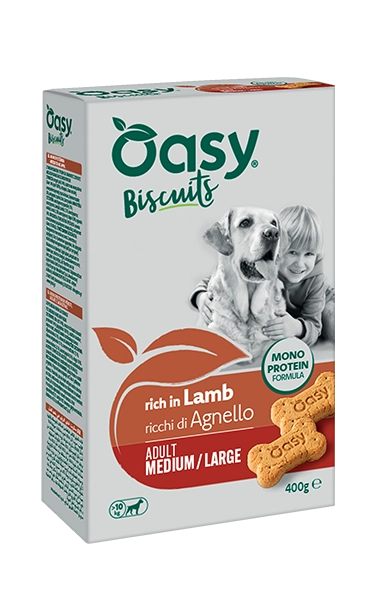
For Oasy Monoprotein Biscuits, for example, the recommended quantity is from 2 to 4 biscuits a day. If you need more treats for your training session, you can divide the biscuit into multiple portions rather than using more biscuits.
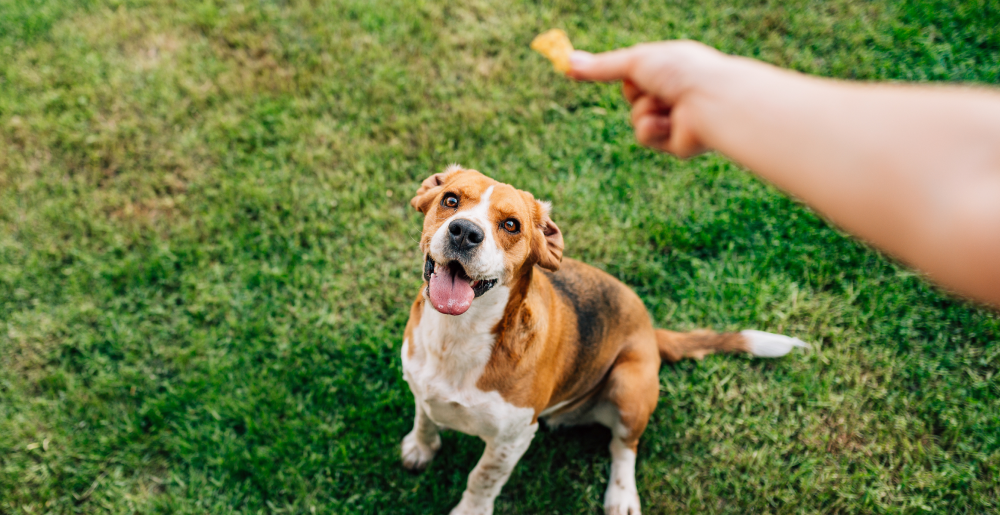
Treats during training sessions are a positive reinforcement: they help your dog understand which behaviour is correct. However, not all treats should have the same “value”. A simple and familiar exercise could be rewarded in a different way compared to new behaviours, a more complex request or an activity performed in the middle of many distractions. The choice of the rewards could therefore change according to the situation and to what seems to motivate your dog more, as explained in the article “Dog Training: Using Treats as Positive Reinforcement”.
When the reward is a snack, this rule is always valid: snacks should be included in the daily energy intake.
If your training session requires several treats, it’s important you consider them as part of the total daily food amount.
One helpful strategy is to use part of the daily kibble amount as a reward for the easier and already known exercises, keeping the tastier treats for new or more challenging commands.
Duration matters too: short and well-organized sessions allow you to work with more precision, keeping the snack quantity under control.
When your dog has appropriately learned a command, you shouldn’t reward them each time they execute it. Rewards can be progressively alternated with a cuddle,a toy or a praise.
This is important to keep the positive value of the interaction without always relying on food. You shouldn’t abruptly stop offering them treats, but simply widening the reward options for your dog, adapting methods and reinforcements to age and specific educational pathway the dog is undergoing.
This is why we collected information and specific exercises in our guides
“How to educate an adult Dog: three recommended Exercises” and “
Puppies' Basic Training”.
There isn’t just one right treat for our dogs: shape, texture and size can change based on occasion and characteristics. This is why Oasy snacks ranges include different options, from biscuits to chewing snacks.
Monoprotein Biscuits are a crunchy reward, formulated with a single source of animal proteins and enriched with cereals and fibres. They are ideal also for dogs with food sensitivities.
For a tasty reward you can choose our Snacky range, available in different flavours and with lean proteins and low-fat content.
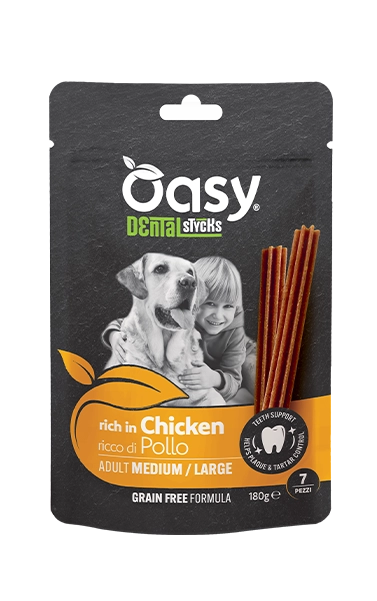
When you want to combine a treat with your dog’s dental care, our Grain Free Formula Dental Stycks have a particular texture that promotes dog’s chewing and contributes to the reduction of plaque and tartar formation. The feeding recommendations suggest you offer 1 stick per day in the size that is most appropriate to the dog.
Our
Bony chewing bones are ideal to satisfy dog’s chewing needs, promoting the wellbeing of teeth and gums.
A little extra tip: when dealing with food intolerances, choosing a monoprotein snacks can be useful, however, sensitivities, intolerances and allergies aren’t all synonyms: in case of a food-related problem, you should choose both product and flavour together with your vet.
Gnawing and nibbling at things is an innate behaviour in dogs, an activity that is part of their nature and for this reason, very pleasing and satisfying for them.
Therefore, it is important to choose a chewing snack that is specifically formulated for dogs, that can allow them to satisfy their natural need safely.
Our Bony chewy snacks are a good example, formulated to offer a longer lasting and more pleasing chewing experience: a way to turn snacks into a relaxing and satisfying activity.
Bone-shaped snacks for dogs aren’t to be confused with real bones. WSAVA recommends avoiding both raw and cooked bones, that could cause injuries or other problems if chewed or swallowed. They also advise against products that are too hard or have sharp edges. So it’s always best to choose a product designed specifically for the purpose.
A small piece of food from the table can also be perceived as a reward from our four-legged friend, but leftovers are never the best choice.
Besides adding calories that are difficult to calculate, they can include ingredients that aren’t appropriate for dogs.
Among the foods that are not indicated for dogs, we have chocolate, grapes and raisins, onion and garlic, macadamia nuts, xylitol, alcohol and drinks that include caffeine. You don’t need to learn the whole list to choose their treats: the simplest solution is to use products that are specifically formulated for dogs.
We discussed this topic in our article “
The 10 Food You Should Never Feed Your Dog (and the Safe Alternatives)”, where you can find the list of foods to avoid and why or how they can harm our pets’ wellbeing.
Rewarding your dog for a correct behaviour with a small treat can be much more meaningful than offering a snack. A rub, a playing session, an enthusiastic praise or an activity they enjoy can turn into a reward that is as pleasing and satisfying as a snack.
For some dogs, it’s a ball they have to catch, for others it’s a rub in their favourite spot. Alternating snacks with these rewards can be particularly helpful when they have already learned a command and you want to avoid associating every positive interaction with food.
WSAVA itself recommends finding alternative ways to spend quality time with our dogs instead of just relying on food rewards.
Playing, for example, is an excellent way to nurture your relationship. And it’s not the only reason: it is also important to develop motor skills and to interact with the world around them. Of course, cuddles are as important.
Knowing where to rub our dogs to make them happy helps building a relationship based on trust, listening and sharing.
A single biscuit rarely has an impact on the daily food amount: it’s more about the small habits that add up daily. Here are some that we should notice:
When there are multiple members in the family, keeping count of the snacks given to the dog might not be easy.
Each one may offer the dog a small snack during the day without knowing someone else did too. If we add all the snacks up, the overall quantity can increase rapidly.
To avoid this, the family should establish one shared rule: deciding the daily quantity in advance, making sure everyone knows how many snacks have already been offered.
A small tip could solve the problem: have the daily amount ready by morning and keep it where all family members can see it. Each one uses it without opening new packs or adding more snacks.
In this way you won’t need to remember who offered what or when. You just need to check. When the snacks are over, no more rewards for the day. A simple system that makes everything easier.
For puppies, choosing the right snacks requires a little more attention. In this stage, their body and their habits are still in constant change. Therefore sizes, texture and recipes must be appropriate to age and size. Choosing snacks for puppies that are specifically formulated for this life stage, such as Monoprotein Biscuits for Puppies, will allow you to offer them more appropriate rewards. Quantities matter too: each snack contributes to the daily total intake. For this reason, they should be considered part of a balanced diet. If you want to find out more, read our article dedicated to puppies’ appropriate nutrition. If you have a senior dog instead, you could pay attention to both texture and size of the snacks, making sure they are still meeting the current needs of your dog. With age their habits may change, as well as their activity levels and energy needs: what worked in previous years may not be good for the current moment, as we explained in the article about nutrition of senior dogs. In case of overweight dogs, pathologies, food sensitivities or prescribed diets, the most correct thing to do is ask your vet for advice, to choose the appropriate food and quantities. If your dog is not very active, in the article “ “Lazy” dogs: what to do? Tips and activities to get back in shape” you will find some suggestions to deal with this situation.
Knowing how many treats we should give the dog means considering many aspects. Quantity, type of snack, preferred moment and ways to offer them.
There are three key points that you should keep in mind:
Among monoprotein biscuits, snacks in pouches and chewy bones, Oasy snack range for dogs includes many options to choose from. Whatever your choice is, the feeding recommendations indicated in the label are always your first reference point for proper usage.
There isn’t just one correct quantity. As general reference, snacks shouldn’t exceed 10% of the daily calorie intake and should be considered part of the daily amount, together with kibbles and wet food. Always follow the feeding recommendations on the packaging and in case of doubts about nutritional requirements, ask your vet.
It depends on the moment and on each dog’s characteristics. A small biscuit can be a practical snack to offer sometimes or during a training session, while a chewing snack is more appropriate for a longer session, always under your supervision. Age, size and dietary requirements should guide your choice.
A nice belly rub, a sweet praise, a playing session or an activity together can be some fantastic rewards for your dog, especially when the behavior is already well established. In our articles “Playing is essential for dogs” and “Cuddling your dog” you can find out why these are a very important and useful way to reward them.
Yes, especially if they have been offered in a significative quantity. The calories of the snacks are to be added to the main food, so you should consider them when calculating their daily ration. The guide: “What’s the right kibble amount to feed your dog? A guide to calculating portions” can help you understand how to handle the correct quantity. To determine the specific nutritional requirements of your dog, always consult your vet.
Yes. A part of the daily ration can be used as reward, especially for all the already well-established behaviours. By taking it from the daily allowance, you will be able to reward your dog without adding more calories. For the most challenging training moments you can use a particularly tasty snack instead.
You must follow the feeding recommendations on the pack, because quantities may change based on the type of product. For Oasy Monoprotein Biscuits, we recommend giving from 2 to 4 biscuits a day. In the calculation you must also consider all the food consumed during the day.
It’s best to avoid it. Leftovers are harder to quantify in terms of dietary balance and certain foods that are intended for human consumption such as chocolate, grapes and raisins, onion, garlic and xylitol are toxic for dogs. To know more about this topic, read “The 10 Foods You Should Never Feed Your Dog (and the Safe Alternatives) ”.







 websolute