When living with a dog, we often ask ourselves what they can or can’t eat, especially when we have leftovers from lunch or pieces of fruit. It’s a common situation and it’s usually done with good intentions. Sharing something seems like a spontaneous gesture. However, when we think about an appropriate diet for dogs, we must understand that what’s good for us is not always good for them.
There are many beliefs regarding dogs’ nutrition: some think that raw meat and a bread slice are harmless, some that dogs that quickly finish their ration are not being fed the right amount. Proper nutrition requires attention, because it can affect their energy, digestion, weight and general wellbeing.
Knowing what dogs are allowed to eat, which foods to avoid and which myths to dispel can help make conscious choices. In this guide, we will show you which foods are not appropriate for dogs, how to recognize reliable information, and why a complete and balanced diet is always the starting point.
Dogs have their own nutritional needs and can’t be fed the food that we normally eat. Even if something is considered healthy, natural or light, that doesn’t mean it is appropriate for their organism. Some ingredients that are a natural part of our diet can be hard to digest for dogs, or too rich in fats, excessively salty and, in some cases, toxic.
A correct diet should provide proteins, fats, carbs, vitamins, minerals and fibres in the right amounts. It’s not enough to feed them something “tasty”: you should feed them what’s appropriate.
A simple example: something like small slice of meat that was prepared together with onion, garlic, sauces or excessive salt will no longer be appropriate for dogs. On the other hand, if meat was selected as a fresh ingredient of a kibbles’ recipe especially formulated for dogs, it becomes a source of nutritional balance that was thought for ensuring a quality protein intake, together with other nutrients which are fundamental for their general wellbeing.
That’s why specific foods for dogs remain the most reliable solution for their daily routine: they are formulated to respect their daily needs and help avoid imbalances that could affect their wellbeing.
To shed some light on which foods dogs shouldn’t eat (a topic that we previously discussed on the article “The 10 Foods You Should Never Feed Your Dog”), it’s important to remember a simple but essential concept: their daily diet should be based on products that are specifically formulated to meet their nutritional needs, not on products that were thought for us humans. Some foods, in fact, must be completely avoided as they are potentially toxic, while others aren’t part of the same risk category, but are still not suitable for dogs.
Distinguishing these two levels can help understand the potential dangers, without underestimating the less risky ones: even if something is not toxic, it can still be wrong, unbalanced or unnecessary for our dog’s diet, that should be complete and specifically studied for them.
Here is a list of the foods you should never feed your dog:
In case of accidental ingestion of these foods, especially if in large quantities, or if symptoms such as vomiting, fatigue, tremors or unusual behavior appear, you should immediately contact your vet. Waiting for the symptoms to be gone is not helpful, a quick intervention can make a difference.
There are also some foods that are not necessarily toxic, but that it’s better to avoid because they can be too heavy, unbalanced or not appropriate for a dog’s needs:
Dogs’ diet is a topic full of questions, but also of misconceptions that have persisted over time without being correct.
One of the most common ones concerns their appetite: if a dog finishes what you feed them right away, it doesn’t necessarily mean that they are still hungry or that the quantity is not enough. Many dogs eat enthusiastically out of habit, competition, greediness or simply because they are used to eating quickly. Unlike cats, they normally finish everything in their bowl. To understand if this reaction is correct, we should evaluate their weight, body condition, vitality and other nutritional information, not just how quickly they finish their ration.
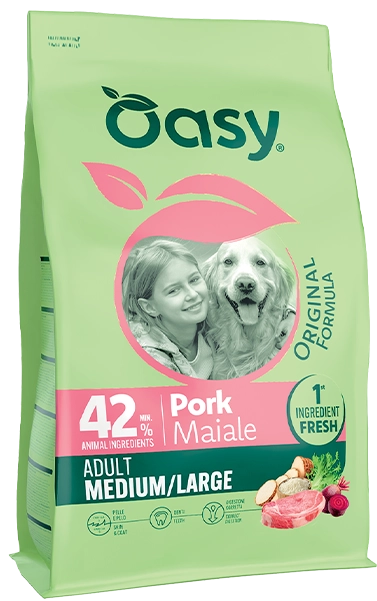
This is why Oasy’s formulations can combine a significant amount of animal ingredients with many functional components that are thought for their daily wellbeing. For example, the recipe of our Oasy Monoprotein Formula Adult Medium/Large Pork includes Omega-3 and Omega-6 fatty acids which are important to keep their skin and coat in optimal conditions. Oasy Monoprotein Formula Mature & Senior Lamb includes Vitamin A, Vitamin D3 and E, carefully studied to support their immune defenses, together with citrus pulp which contributes to fight free radicals.
Raw meat is often the object of many debates. Some people associate it to a more “natural” diet, but this doesn’t mean that it’s necessarily safer.
Dogs can tolerate some kinds of raw meat, but uncooked meat may contain microorganisms, bacteria and parasites and it requires very careful management in terms of hygiene and nutrition.
A study from 2007 has even concluded that pets fed on raw food diets are more likely than those fed commercial pet food to shed Salmonella through their feces, and this may put the people living with them at risk of contamination. This is another reason why a complete pet food that is specifically formulated for dogs remains a safer, simpler and more practical habit.
Eggs shouldn’t be considered as a free addition to a dog’s daily diet. In fact, they are a source of proteins and nutrients that, if balanced with other specific ingredients, contribute to the overall quality of foods.
Oasy Original Formula Adult Small/Mini Lamb is a good example. In this recipe, eggs are included to offer dogs a balanced nutrition that can meet their needs.
Raw eggs require a particular care: egg white contains avidin, a substance that, if taken frequently, can obstruct the assimilation of biotin; moreover, the shell could be contaminated by Salmonella, with potential hygiene risks.
Bread, pasta and rice that we usually consume should not become a habitual addition to our dogs’ daily diet. In this case as well, in fact, the topic is not eliminating carbs completely but understanding their role when they are included in a complete and balanced formula and in correct quantities.
For instance, rice can be a good source of highly digestible carbohydrate, naturally gluten free. Just like in our Monoprotein Formula Adult Medium/Large Lamb. Feeding them bread, pasta or rice in addition to other foods could alter their daily balance and increase their caloric intake without real benefits.
No. One of the most common misconceptions is that bones are always natural and therefore safe treats. Bones, in fact, could chip and cause dental problems, while the ingestion of excessively large pieces could cause serious digestive problems or damage to the esophagus and digestive system.
If you want to satisfy your dog’s chewing needs you can always choose specific products, such as our chewy bones.
Firstly, good daily nutrition should be tailored to each dog’s needs. There isn’t a single formula that can be appropriate for all. A growing puppy, an active adult or a calmer senior dog have different nutritional needs. The same principle applies to small breed and large breed dogs, or for a sterilized subject compared to a very active one.
Quality of ingredients is important, and so is the overall coherence of the recipe. A complete pet food should provide a balanced nutrients intake, be appropriate for each life stage and be fed following the specified amounts. To understand better how to manage their needs, rations, mixed feeding and tips for different life stages, in the “Nutrition” section of Oasy Magazine you will find many in-depth articles that will help you make the right choice. Looking for information is a concrete gesture of care, because it allows you to distinguish between reassuring habits and choices that can be truly helpful for their wellbeing.
In case of doubts on your dog’s nutrition, your vet should be the main reference point, especially if your dog presents conditions such as being overweight or suddenly losing weight, frequent gastrointestinal problems, suspected allergies, recurring itching and chronical diseases.
It’s important to ask for help even when a dog swallows potentially toxic food, particularly if it’s chocolate, grapes, raisins, xylitol, onion, garlic, alcohol or caffeine. In these cases what really matters is rapidly getting in touch with a professional, explaining what happened in detail.
Finally, the vet can help distinguish between a simple food curiosity and a real nutritional need. Dogs don’t need everything they ask; not everything they like is good for them.
Building a correct diet means learning to say no, because that’s how you can protect their wellbeing.
No. Chocolate is one of the most common foods to avoid, but it’s not the only one. Many foods in our diet aren’t suitable for dogs because they are too salty, fat, heavy or cooked with potentially dangerous ingredients such as onion, garlic, grapes, raisins, alcohol or sweeteners such as xylitol. That’s why ruling out a single food is not enough: a diet for dogs should be based on products that are specifically designed for their needs and isn’t based on what we have on our dinner table.
It depends on the kind of food, on the quantity and on the dog’s characteristics. However, some foods can be dangerous even in small quantities. This is the case, for example, with xylitol, grapes or raisins, while for other foods, risk can grow with the amount they ingested. Since it’s not always easy to evaluate how dangerous the situation could be, in case your dog has ingested something potentially toxic, the most cautious thing you can do is contact the vet.
No. High palatability doesn’t make food nutritionally good for them. A dog can be very drawn to something particularly fat, savory or with a strong smell, but this doesn’t mean these foods are appropriate for a daily diet. Even if they seem to enjoy eating them, this has no real benefit for their wellbeing. To make a good choice, what matters is the overall quality of their diet, not just the enthusiasm they show while eating.
Preparing homemade meals doesn’t automatically mean offering them better nutrition: without a specific nutritional plan, you may create an unbalanced diet, lacking or exceeding some nutrients. Food that is specifically formulated for dogs aims at providing them with a balanced and complete intake, measured for their needs. That’s why every dietary choice that isn’t part of their routine should be evaluated with particular care.








 websolute