Taking care of our cats means paying attention to their wellbeing everyday. Choosing an appropriate diet, with quality ingredients and carefully studied recipes are all important actions. But there is also another aspect that weighs on their balance: the quantity of food we feed them.
Offering a bigger ration as an act of love or reducing it excessively to avoid weight gain isn’t helpful to the establishment of a correct routine. Balance comes from a good combination of quality and quantity: the right product, the right amounts, based on each cat’s needs.
In this guide we will find out how much dry food we should feed our cats, what are the key factors that affect the daily ration and how to choose depending on weight, age, sterilization and lifestyle.
The kibble quantity isn’t the same for every cat because it depends on weight, age, sterilization, health conditions and activity levels.
Estimating quantities by eye could seem practical, but the risk of creating small imbalances is high. One little extra each day will become a significative extra food over time, especially if your cat is sterilized or not very active.
On the contrary, an excessively reduced amount won’t satisfy the daily requirements of our four-legged friend.
The simplest solution is measuring kibbles with a digital scale and using the nutritional charts of the product you chose. Over the following weeks, observing your cat (weight, energy level, appetite, body condition and behaviour) will help you understand whether the quantity is okay or modified with the help of your vet.
To understand how much a cat should eat, you must consider the following variables: weight, age, sterilization and activity levels. But keep in mind that the correct portion comes from taking all factors into consideration.
An adult cat that lives mainly inside and isn’t very active will have different needs compared to a very active and playful cat. A sterilized cat requires an even more careful food management. Finally, a senior cat could have specific needs due to this particular life stage.
To establish a balanced diet routine, you should start from the basics of feline nutrition. In our articles:
“Guide to feeding your kitten”
“How to feed your adult cat”
“Feeding senior cats: a complete guide to their wellbeing”
you will find more information about kittens’, adult cats’, senior or sterilized cats’ daily requirement and about which aspects you should look for every day.
To figure out the right amount of dry food, the ideal weight is the reference you should choose, and not their current weight. This is particularly important if your cat is overweight: measuring their ration according to the real weight could show an excessive energetic intake and make it harder to find the right balance again.
The ideal weight depends on physical structure, breed, age and body condition, and it should be defined by your veterinarian. From this assessment, you can decide what’s the correct daily amount.
More practically, you can use the nutritional chart on the food package as a starting point. Many products already suggest different amounts based on the objective, such as weight maintenance or weight loss. However, if you still have doubts, always ask for more professional advice.
After sterilization, a cat’s energy needs tend to decrease, while their appetite may increase. This combination explains why many sterilized cats are more at risk of being overweight, especially if they live indoor and are not very active.
In this case, our advice is to choose foods specifically formulated for sterilized cats, which are already studied to balance satiety, energy intake and urinary wellbeing through specific formulas and functional ingredients.
Age matters too: a growing kitten, an adult and a senior cat don’t have the same nutritional needs. This is why the second main rule is always choosing a food that is appropriate for their life stage: Kitten, Adult or Senior.
Levels of physical activity can change from cat to cat. Some cats sleep a lot and don’t love to play, while others are more curious and like to run and explore.
In this case, rather than observing their single movement, just look at their overall habits and try to understand how active your cat is during the day. Are they climbing on shelves and furniture? Do they alternate between rest and activity? Or do they tend to move slowly and prefer to relax?
All this information can help you read the nutritional chart on the package. The quantity for a less active cat could be closer to the minimum amount indicated, whilst a very active cat could be closer to the maximum amount. The dose should always be used as a guide and adjusted gradually, considering weight, physical condition and general wellbeing.
You have two choices: the practical method, that is following the feeding guide on the package, and the technical methos, based on cat’s daily energy requirement. For most people, the product’s nutritional guide is the simplest, fastest and safest way.
The most important aspect to remember is that the ration is always daily. If you have the daily grams indicated on the packaging, that quantity should be divided into multiple meals during the day, not repeated for every meal.
The more practical way to understand the daily kibble amount is taking the nutritional chart as reference. At Oasy, they are available also on cat products’ single pages.
For example, the nutritional chart on our Superior Formula Adult Sterilized Tuna kibbles crosses cat’s weight with target weight. This allows you to have a correct starting point that you can adapt to your cat’s needs and routine.
However, it’s important to always refer to the product you have chosen. Each recipe has a different calorie density: two products can look similar but provide different energy amounts in terms of grams. That’s why, when you switch products, you must read the new nutritional chart and calculate the ration again.
The measuring cup should also be used with care: if you use one from a different product, it might not correspond to the correct quantity. Measure the kibbles on a digital scale at first and observe your cat’s reaction over time.
There’s also a technical method that is used in veterinary medicine that starts from the daily energy requirement. The calculation considers body weight and other factors such as age, sterilization, physical condition, activity level and target weight.
This method is useful when you need a more precise evaluation, for example in case of overweight cats, pathologies, weight loss or particular needs. However, you shouldn’t “create” your own formula: if your cat has specific needs, it’s always best to ask your vet for advice, to determine the correct dosage.
Considering a 4kg sterilized adult cat as an example, using Original Formula Adult Sterilized Beef, the daily suggested amount is:
If you’re using Grain Free Formula Adult Sterilized Chicken, a product from our grain free range, the daily suggested amount for a 3-4 kg cat is:
This example shows us why there isn’t just one valid quantity for all products. Even for cats of the same weight, the daily amount changes based on recipe. Besides, the suggested daily amount may vary according to physical activity levels: this is why the charts always indicate just a starting point, that must be verified in every day life.
A nutritional chart can be a precious help to start with, especially if you want to manage your cat’s diet with knowledge and care.
The table below shows an example that is based on two Oasy products: Superior Formula Adult Chicken and Superior Formula Adult Sterilized Chicken.
It’s a practical help to understand how the daily amount can change according to weight, sterilization and, in case of specific food for sterilized cats, even to nutritional target, such as weight maintenance or loss.
The range also helps consider our cat’s lifestyle: a sedentary subject could be closer to the lower value, while a more active cat could need a quantity that is closer to the higher value.
Examples of daily amounts for an adult, unneutered cat: Superior Formula Adult Chicken.
3-4kg: 53-64 g/day
4-5kg: 64-74 g/day
5-6kg: 74-84 g/day
6-7kg: 84-93 g/day
Examples of daily amounts for a sterilized adult cat: Superior Formula Adult Sterilized Chicken
3-4kg: 44-53 g/day for weight maintenance; 30-37 g/day for weight loss
4-5kg: 53-62 g/day for weight maintenance; 37-43 g/day for weight loss
5-6kg: 62-70 g/day for weight maintenance; 43-48 g/day for weight loss
6-7kg: 70-77 g/day for weight maintenance; 48-53 g/day for weight loss
7-8 kg: 77-84 g/day for weight maintenance; 53-59 g/day for weight loss
A sterilized cat should eat an amount that is appropriate to the new energy requirement, and a food that is specific to this life stage. After sterilization, metabolism slows down and their appetite tends to increase.
These are the first signs you should notice in case of excessive weight gain: their waist becomes less visible, their ribs are more difficult to feel when you touch them, and your cat becomes slower or asks for food insistently. Don’t wait for a major weight increase to do something, small and timely adjustments are easier to manage.
A specifically formulated product for sterilized cats can help you manage the needs that are typical of this case. You can read more about it in our guide: “Food for sterilized cats: a complete guide to manage their nutrition”.
The total amount is to be considered for the whole day; therefore, it should be divided into multiple meals. This will help you avoid mistakes in quantity and makes it easier to control how much our cat actually eats. Meal frequency depends on age, habits, and family routine. Generally, growing kittens, adults, senior and sterilized cats have all different needs, but all of them need a daily diet management, that should be balanced and respectful of their nature. If you are interested about this topic, you can read our article “How many meals should cats have in a day? A complete guide.”
To make sure that the kibbles amount is appropriate for our cat, we must observe our feline friend over time. Even if we are following the correct guidelines, it’s important to notice how our cats react over time.
A useful indicator is body condition, which is often assessed in veterinary practice using the Body Condition Score. In practical terms, a cat that is in good condition should have ribs that you can feel at touch but not too visible, and a waistline that is clearly visible from above. The side profile shouldn’t appear “heavy” in the abdominal area.
Besides the body shape, you should also monitor their weight regularly, always in the same condition, and pay attention to their appetite, energy, coat and use of the litter box. If weight increases or decreases in a visible way, if your cat seems always hungry or leaves food in their bowl, you might need to adjust their portion.
Adjustments should be made gradually. Sudden changes could disrupt their routine and make it harder to understand what really works for them. If you have doubts, especially if your cat is sterilized, senior or overweight, always consider your vet as your point of contact.
Measuring kibbles can seem easy, but it’s also easy to make small mistakes during your routine. Over time, this could affect your cat’s daily dietary balance. Being aware of this can help prevent problems and manage the daily ration:
Quantity depends on the target weight, age, sterilization, activity levels and product. You should always read the nutritional chart, as it changes depending on brand and product. For example, Superior Formula Adult Chicken indicates 74-84 grams a day for a 5-6kg in cat.
It depends on the product and on the cat’s physical condition. Our Original Formula Adult Sterilized Beef, for example, suggests 50-60 g each day for the maintenance of a sterilized adult cat of 3 or 4 kg, while our Grain Free Formula Adult Sterilized Chicken recommends 43-52 g a day.
A sterilized cat has often lower energy requirements compared to before sterilization, while their appetite might increase. This is why you should adjust the amount and read the nutritional guidelines of the specific food.
You can do it only if you can still control the quantity. If the bowl is always full and you don’t keep track of how many kibbles you poured, it’s hard to know how much your cat actually eats each day. Weighing the portion allows you to control quantities more precisely, especially in case of sterilized, sedentary or overweight cats.
Consider their physical condition, weight and behavior. If you can hardly feel the ribs, if their waist is not visible or their weight increases, the amount could be excessive. Weighing your cat regularly will help you keep it under control. In case of important changes, you should ask your vet for some advice.
To calculate the correct kibble amount to feed your cat, always start with:
There isn’t just one correct amount of food for every cat, but you can start with listening and observing yours: the product you chose, their lifestyle, the stage they are in and their daily wellbeing. That’s why weighing the ration, observing their body and choosing quality recipes are important aspects that nurture your Love every day.
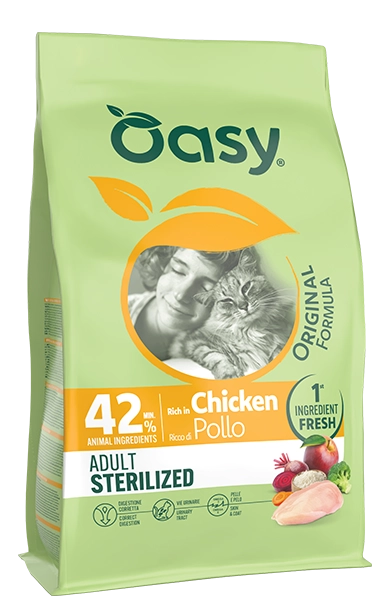
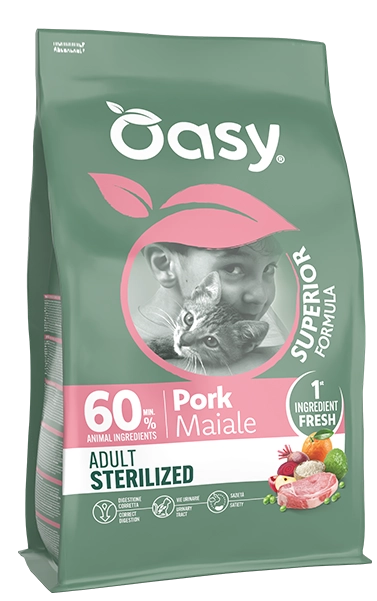
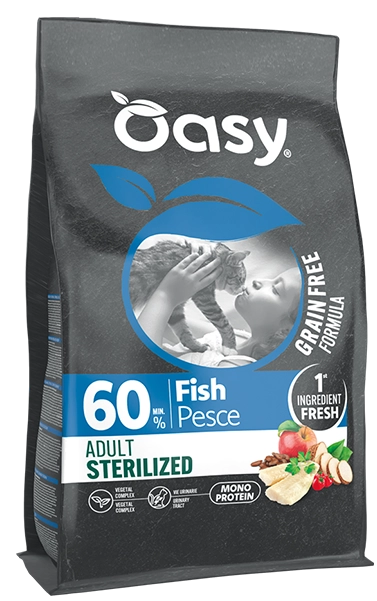
To find the most appropriate solution to their routine, you can look at Oasy dry cat foods, that were thought to satisfy multiple different needs with complete recipes.








 websolute