When thinking about our cat’s diet and nutrition, some questions may come to mind: how many times should they eat? Should I feed them a single meal or more during the day? What can change between kittens and sterilized cats?
Just like we talked about meal frequency for dogs, there are some good practices for cats as well. There aren’t universally valid rules, but simple indications to consider, starting from observing our cat’s habits and characteristics: their appetite, their weight, their level of activity during the day, their relationship with food. In fact, frequency can change depending on age, lifestyle and specific needs.
Kittens, adult cats, senior or sterilized cats have different needs, but they all can certainly benefit from a meal management that is regular, balanced and respectful of their nature. In this guide dedicated to meal frequency for kittens, adult and sterilized cats, we will understand how many times our feline friends should eat during the day, so that we can take care of their daily balance as well.
The most important reason for meal frequency is that, in nature, cats don’t tend to eat large quantities of food all at once. Instead, they are more inclined to have smaller meals throughout the day, a habit that instinctively comes from their predator behavior.
When living at home, cats still keep this natural predisposition. In the wild, they wouldn’t have just one large meal, on the contrary they would consume smaller rations at different times.
This is why dividing their daily amount into multiple smaller meals could be more respectful of their natural rhythm, promoting better digestion and keeping their satiety under control.
There’s also another aspect to consider: for cats, a meal is not just food intake. It’s a moment that can weigh on their daily balance. If the approach is too strict or, on the contrary, too lax, it can make them more persistent and voracious or disorganized in their relationship with food.
This doesn’t mean that there’s just one right method for everyone. Frequency of meals can change depending on age, physical condition, activity level and on the type of diet we choose. However, the main principle is always the same: for cats, small and frequent portions are generally more appropriate than a single larger meal.
A cat’s dietary habits aren’t the same at each moment of their life. Frequency can change as they grow, with metabolism and different body needs: kittens require to eat more often, adult cats need a balanced routine, while senior cats could benefit from smaller and better distributed meals.
In order to really understand how often a cat should eat, that’s where you should start: their age.
Kittens should eat multiple times a day because they grow quickly, use a high amount of energy and still have a small stomach.
Generally, during this period, their daily food portion should be divided into 4 meals, that could also turn into 5 immediately after weaning or for tinier kittens.
Offering small and frequent portions keeps their energy levels more stable during the day, avoiding keeping kittens without food for too long.
Moreover, a kitten’s nutrition requires a series of useful tips to build a routine suitable for their first months, such as having access to small food quantities during the day and having a correct vitamin intake to support their nutritional and immune system, just like in our Oasy Superior Formula Kitten Tuna. In this stage, it’s useful to observe their appetite, feces, vitality and growth, as these factors could help you understand if the routine you established is well balanced.
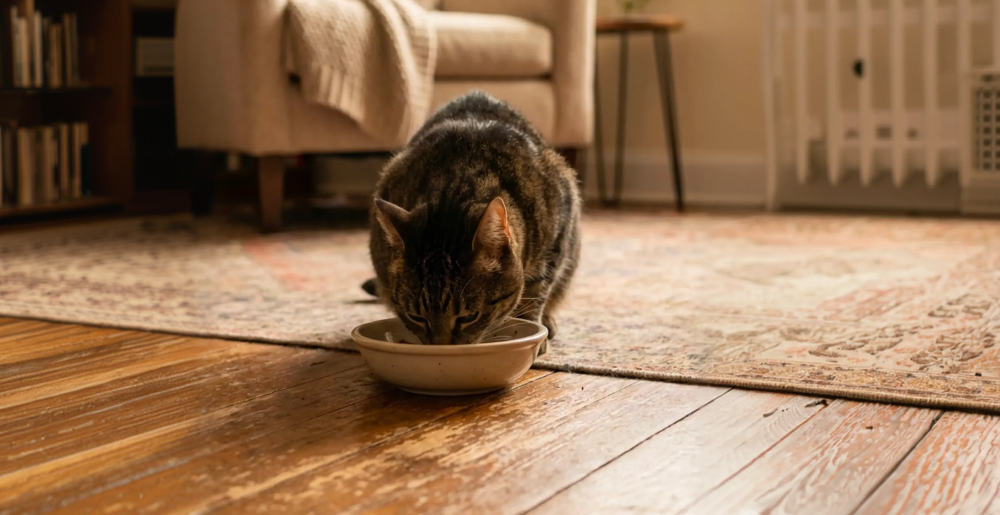
A healthy, adult cat generally eats 2 or 3 times a day. In most cases this is the best way to meet their daily needs without overfeeding them or leaving them without food for too many hours.
As they reach adulthood their growth rhythm becomes more stable, but nutrition should always be a priority to focus on. In fact, it is exactly at this moment that their dietary routine has a concrete effect on maintaining the target weight, on their energy levels, digestion and quality of life.
Adult cats no longer need the same frequency as kittens, but they still need regular and well distributed meals that are in line with their lifestyle.
For example, cats that live indoors and aren’t very active can benefit from 3 small meals during the day, to handle their hunger and avoid persistent food requests. More active cats with good self-control and a consistent routine can also go with 2 meals a day. Evaluation should always be done considering the main general elements: age, activity levels, appetite and potential digestive sensitivities.
To learn more about nutritional needs, recommended ingredients and good daily habits, you can read our article on How to Feed Your Adult Cat, where you will find a complete overview of this delicate but fundamental part of a cat’s life.
The aging process is not the same for all cats. Some keep being active and maintain good muscle mass, while others become sedentary and more selective when eating or more sensitive to texture or flavor changes.
In most cases, as we explain in the article Feeding senior cats: a complete guide to their wellbeing, what really makes the difference is knowing your four-legged friend, feeding them the right quantity of calories and most of all, paying attention to the nutrients that can support them during the typical changes of this life stage. Glucosamine and chondroitin sulphate are good examples: they are included in Oasy Superior Formula Mature&Senior and support correct joint mobility in senior cats.
About frequency, a senior cat can generally keep having 2 or 3 meals a day but often benefits from smaller portions.
They may not enjoy excessively rich meals, while moderate portions can support digestion. If your cat tends to eat less each time, dividing the ration into 3 meals can be a good idea. While if they have a regular and consistent appetite, 2 well-balanced meals can be enough.
After sterilization many cats consume less energy but tend to crave more food. That’s when you need to pay attention: letting them eat in a disordered way or feeding them a large ration in just one moment can lead to a gradual weight gain, not visible at first.
As explained in the article Food for sterilized cats: a complete guide to manage their nutrition, after sterilization, the most important aspect is establishing a new daily dietary routine, as well as choosing the right food type. Normally, dividing their ration into 2 or 3 meals, just like what we do for adult cats, helps avoid excesses, maintaining their sense of satiety and reducing the constant craving of food.
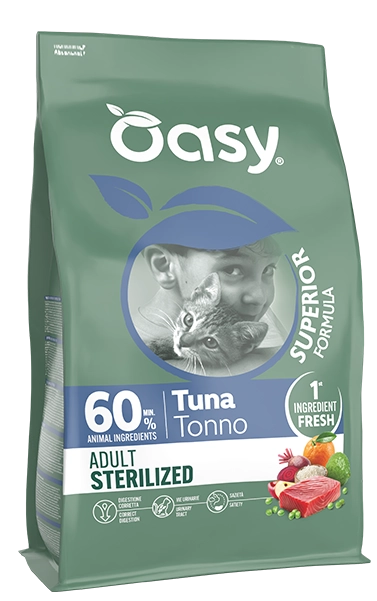
It is the food choice that can really make a difference. Products formulated for sterilized cats can actually support their daily routine, such as the ones included in the Oasy Superior Formula Sterilized range, with a balanced caloric intake and specific ingredients to support weight control and urinary health.
Of course, movement, play, hydration and attention to quantities remain fundamental aspects, keeping our sterilized cats satisfied with their meals without exceeding.
Combining dry and wet food for a cat’s diet can be a useful idea, as it allows us to put convenience, nutritional completeness and increased water intake all together. If managed appropriately, mixed feeding helps to make diet more varied and provides good daily hydration.
In fact, many cats usually drink less than we may think. This aspect derives from their nature, that’s why wet food can play an important role in their daily routine. Adding it to dry food not only means diversifying textures and flavors but also increasing the fluid intake through food.
From a practical point of view, mixed feeding can be easily arranged: one portion of wet food and one or two portions of dry food during the day, always respecting the daily total amount. What’s really important is not to combine the two food types “casually”. Dry and wet food should be well balanced in their daily diet.
In our selection of cat products you can find many different solutions that meet your cat’s needs with quality and nutritional balance. If the Oasy dry ranges for cats are formulated to provide complete and balanced nutrition, with selected ingredients and recipes based on different life stages, the Oasy wet ranges complete the offer with tasty and accurate recipes, combining taste, quality and hydration in one product.
For us at Oasy, that’s exactly what it means to appropriately feed a cat: respecting their nature, supporting their needs and offering them carefully formulated products and recipes. Because feeding is never just about food. It’s raising your pet naturally, with responsibility and quality, ensuring their wellbeing every day.
If you want to know more, find out all our options based on the different stages of life:
Products for kittens
Products for adult cats
Products for senior cats
In most cases, this is not an ideal choice. Just one large meal a day doesn’t reflect their natural behaviour and doesn’t help maintain a balanced routine.
Some cats can adapt to it, especially if they have really stable habits, but this doesn’t mean this is the best solution. Concentrating the total amount in one time doesn’t respect the small-and-frequent-meals logic, which typically belongs to the feline species.
If possible, it would be better to divide the daily amount into 2 or 3 meals. This is a matter of daily wellbeing and respect for their natural characteristics.
Always leaving their kibbles available can work in some cases, but it’s not ideal for all cats. For a normal weight cat which can self-regulate and has regular nutritional habits, there shouldn’t be any problems. On the contrary, if a cat tends to eat too much or too often, it’s better to avoid it.
For some sedentary or sterilized cats, having kibbles available all day can be risky as it may lead to a weight gain.
There’s not a “perfect” time of day, as for cats, what really is important is for mealtime to be predictable. Eating every day around the same time helps them feel more secure and experience this moment more peacefully.
Some cats are more active in the early hours of the day and of the evening, that’s why feeding them at these moments can be a good idea, even from a behavioral point of view.
The most important aspect, however, is avoiding an irregular schedule or continuous changes in time. Cats really love routine and live better when they know what to expect. That’s why a simple routine, tailored to their real needs, is the best solution for their wellbeing.





 websolute