

A chance encounter while on a walk, a relative bringing their dog while visiting, the arrival of a second dog in the family: there are plenty of situations where two dogs might have to share a space, for a couple of minutes, a few hours or for the rest of their lives.
Every dog has a different personality, that’s why, when we talk about dogs socialising, we shouldn’t imagine inseparable friendships. The main goal is finding conditions to make the encounter safe, without forcing them and respecting their own pace.
In this guide, we will see how to help two dogs socialise in different situations: from their first encounter to going on a walk together, from managing mealtimes to living together at home, all the way to the signs that indicate when it’s best to ask for help from a professional.
When two dogs meet, we tend to link every behaviour to the concept of hierarchy among dogs. However, nowadays this interpretation may result too strict and not be useful to understand what is really happening.
A dog that moves away might just need more space. A dog that growls may be expressing discomfort and trying to prevent the situation from getting worse.
Instead of wondering which dog should prevail, we should just be able to read their encounter and make sure they can keep an appropriate distance, if they are able to escape and move freely.
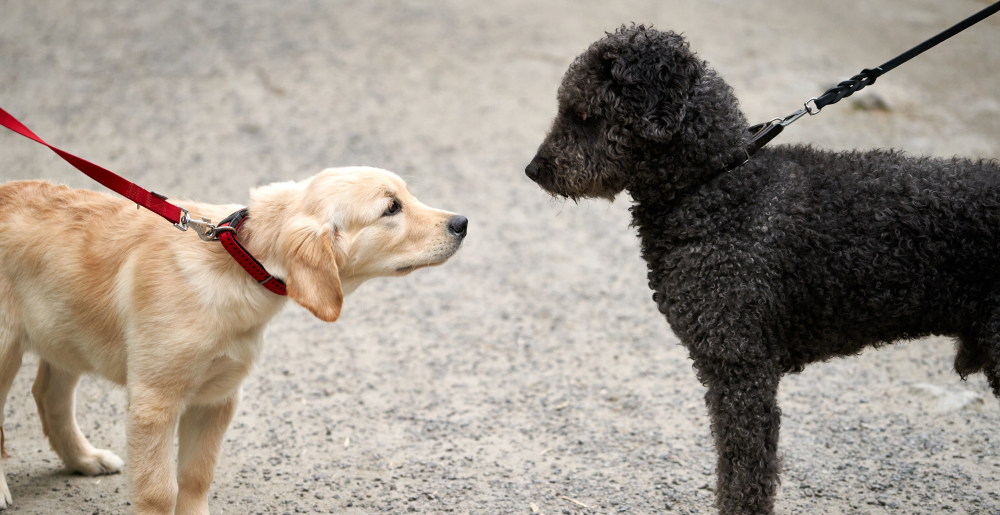
When two dogs meet for the first time, the first thing to do is choose a neutral place, letting them get closer gradually and end their encounter while things are going well.
The first encounter is important as it lays a foundation. It doesn’t determine everything, because dogs will know each other better with time, but it can facilitate or complicate the next steps.
That’s why you should plan it carefully, especially if one of the two dogs gets excited easily, isn’t used to having other dogs around or is quite territorial.
It would be better to avoid sudden appearances at the house door, on the elevator or in other small spaces, as these could increase the tension. Dogs communicate also by walking in a curve, sniffing, or changing their distance: if the space is too narrow, it will be harder for them to communicate.
The first encounter should happen in a neutral place for both dogs, it should be a quiet and wide enough place, to allow them to move freely. A not so trafficked park, a quiet street or an open space can work better than the house of one of the dogs.
A house is a place full of meanings for a dog, and letting an unknown dog in could initially create discomfort, especially if the resident dog usually considers the house as a safe place.
What about a dog park? It could seem an obvious choice, but it’s not always ideal for the first encounter.
If it’s not too crowded and big enough, it could work. But if you notice other dogs, toys, or continuous entries or exits, the situation may change. This is why you should avoid the dog park at first and avoid unpredictable incitements.
When introducing two dogs for the first time, the leash should be still on, but loose. A taut leash will limit their movements and won’t allow them to get closer naturally.
Two handlers should be present, one for each dog. The dogs must never be pulled towards each other; they should show curiosity and decide their distance peacefully. Our body matters too: physically getting between them or showing stiffness could increase the tension.
Avoid sudden pulling or continuous recalls. If one of the dogs pulls hard on the leash, you should work more on this aspect, because this could make any encounter more difficult to handle.
If you would like to know more about this, look at our article on
why dogs pull on the leash.
Generally, the first encounter should be short. A few well-spent minutes are better than a long but negative encounter. Stopping while everything is going well will help the dogs keep a positive association and makes it easier to repeat the encounter.
If the dogs will sniff each other, walk close to each other or ignore each other, it could be already enough for the first time.
To close the encounter, we shouldn’t pull them away abruptly. We can simply start walking in different directions and recall our dogs. The most important thing is for the separation to be as natural as possible.
Parallel walking while keeping a distance is often the easiest way to let two dogs have a positive experience.
Parallel walks are a good solution because they reduce the tension of a head-on encounter. Dogs can observe each other without being forced to handle direct contact. Based on how they communicate, it’s possible to gradually reduce the distance.
If they both look calm, we are on the right track. If one dog looks stiff, is pulling towards the other one, or is trying to move away, you should proceed more slowly.
During the first meeting between two dogs, we should pay attention to food.
Kibbles and snacks could play an important role, but two dogs that don’t know each other still don’t have a shared way of managing them. Using them too early could turn into a first source of tension.
This means that food should be used in the right way and at the right time and once you make sure the environment is calm and stable.
Once the dogs already had a way to meet each other at a distance and with no pressure, a snack (such as
Monoprotein Biscuits) can help strengthen positive behaviors such as looking at the other dogs without tensing up, staying close to their human and responding to recalls.
If you want to offer them a treat, offer one for each dog and ideally, from both people present. There shouldn’t be any competition..
The principle is always the same: positive reinforcement and rewarding positive behaviors. In our article “
Dog Training: Using Treats as Positive Reinforcement” you’ll find a helpful in-depth look at the method to use. In dog-to-dog interactions, the logic remains the same, but they require extra attention.
For two dogs that don’t know each other but will live together, the first days at home and the organization of meals, bowls and toys are extremely important.
The rule is simple: starting with meals in separate rooms or distanced places, playing with one dog at a time, at least until their life together seems more balanced.
These are all small solutions that could prevent conflicts.
Even two dogs that get along well could have trouble sharing important resources, especially if they don’t know each other that well.
Each dog should have their own space to eat, rest and play without feeling observed or threatened. With time, if everything goes smoothly, you could consider relaxing the rules a little, but there’s no rush.
Dogs playing together could look a little intense: they run and chase each other, nip, jump and growl a little. This is all part of a regular interaction.
Signs of healthy dog play include:
A helpful way to find out what is happening is interrupting the play for a few seconds and observing. If both dogs go back to find each other, they were just playing. If one of the two takes advantage of the break to run away, it means the interaction was becoming too intense and shouldn’t be resumed.
Other signs are included in a normal interaction: yawning, looking away and sniffing the ground aren’t necessarily indicating trouble. They all are ways dogs use to regulate their distance and to tone down the intensity of the encounter.
Making two dogs that live together get along well means being committed to building a routine that respects their own spaces and avoids competition. A peaceful life together is achieved one day at a time, through well-established habits and a careful management of their relationship.
Each dog should have their own place to rest. A dog bed, a rug or a quiet corner of the house must remain space spaces where the other dog shouldn’t disturb.
Attentions must be well managed too. Make sure that cuddles, playing and walks outside don’t turn into a competition.
Dedicating some time to each of them individually helps both dogs: the “first” one won’t lose confidence, while the newcomer can build a bond with the family without always having to share the limelight.
Preparing to go for a walk, returning home and distributing their meals are usually the most exciting moments. In these cases, you should keep the habits as simple as possible, making sure your voice is calm as well.
If one of the dogs struggles to cope with the wait, some basic exercises on self-control can be helpful, such as the ones you find in “How to educate an adult dog: three recommended exercises”.
When you bring a new dog at home, the resident dog’s behaviour could change: they may withdraw or seek more attention, guard certain areas, closely observe the newcomer or become less involved in family life. It’s not about “jealousy” (the way humans understand it), but it’s a normal reaction to a big change.
In the first few days of the arrival of the new dog, remember to change the resident dog’s habits as little as possible. Mealtimes, walks and moments together should remain unchanged. This will help the dog to not experience the new arrival as a loss of their points of reference.
At the same time, you shouldn’t force closeness. If the resident dog chooses to withdraw, you must respect it. That may need time to observe and adapt. Make sure they feel that their space, their habits and their bond with the family are safe. This is the right way to handle this delicate moment with care.
The gender factor could affect the two dogs’ first meeting and their relationship, but it’s not the only variable. Two male dogs can peacefully live together, two female dogs can build a positive balance, while a mixed couple doesn’t automatically guarantee harmony.
These are the factors that matter:
If a dog is highly jealous of their food and spaces, any pairing will be hard. While if a dog is well-balanced, used to interacting with other dogs, every situation will be easier.
Therefore, no gender combination will guarantee you success, nor there is one that rules it out. Above all, it’s important to assess each dog individuallyand to plan the integration in a respectful manner.
In case of doubts, especially before adopting a second dog, there’s a golden rule that’s always valid: ask qualified, professional dog trainers for advice so you can make a wise choice.
When an adult dog meets a puppy, the dynamics are different compared to two adult dogs meeting. Puppies are curious and full of energy but can be insistent and not realise when to stop. Adult dogs, on the contrary, have more established habits and should therefore be respected.
An adult dog moving away from a puppy is not necessarily refusing them. They’re communicating a boundary. If the puppy persists on interacting, it’s our responsibility to calmly offer our puppy an alternative to play with, leaving a calm space to the adult dog.
An encounter between two adult dogs could require some graduality as well. Both have past experiences and more established preferences. Some dogs can communicate very efficiently, while others are more rigid and less accustomed to having other dogs around. In this case, you should pay more attention to the integration process: parallel walking, brief encounters, separate resources and no hurry.
If we are planning to introduce two dogs, sometimes the most responsible choice is asking a vet or a dog trainer for advice.
If conflicts persist, if they bite each other aggressively or if we notice signs of stress in one of the two dogs, consulting an expert is recommended.
Other signs that we shouldn’t ignore are, for example, obsessive control from the other dog, difficulty eating or resting, frequent growling, persistent chasing or strong fear.
A professional can observe the situation and the context and develop a plan that is appropriate to the dogs and the family.
In case of brawls, never put your hands or body between two dogs that are fighting. It’s better to prevent these situations from happening with correct management, and to ask for help before it happens again.
It depends on age, temper, past experiences and context. Generally, we should consider weeks rather than days. When two dogs can relax and sleep in the same room without keeping an eye on each other, it’s normally a positive sign.
Choose a neutral and calm place, loose leashes, one handler per dog, and let them approach each other slowly. It’s better to start with a parallel walk and keep the encounter brief, ending it while it’s still going well.
It’s better not. Food is an important resource and two dogs that don’t know each other still don’t have a shared way to handle it. Later on you can feed them a snack to each dog, with one handler per dog, making sure you’re not creating any competition.
Prevention is the simplest rule: distance their bowls during mealtime or keep them in separate rooms, play with each of them individually until their relationship seems peaceful. It shouldn’t be considered as a punishment, but simply as a temporary measure to avoid unnecessary tension.
Yes, it’s possible to make two dogs live together. Gender is just one of many factors. There are others that can count more, such as age, personality, experiences, neuter status. There isn’t a combination that guarantees harmony nor one that rules it out.
Observe their behaviour: if they withdraw, seek more attention, they take up space or look more tense. Keep their schedule identical, make sure you find individual time with them and don’t force closeness with the new dog.
Ask for support if conflicts become frequent, if one of the two dogs shows signs of constant tension, if there are bites that leave marks or can’t relax at home anymore. Intervening early on is not a failure: it’s a concrete way of protecting both dogs’ wellbeing.
When introducing two dogs for the first time, pay attention and don’t rush things.
The most important steps are:
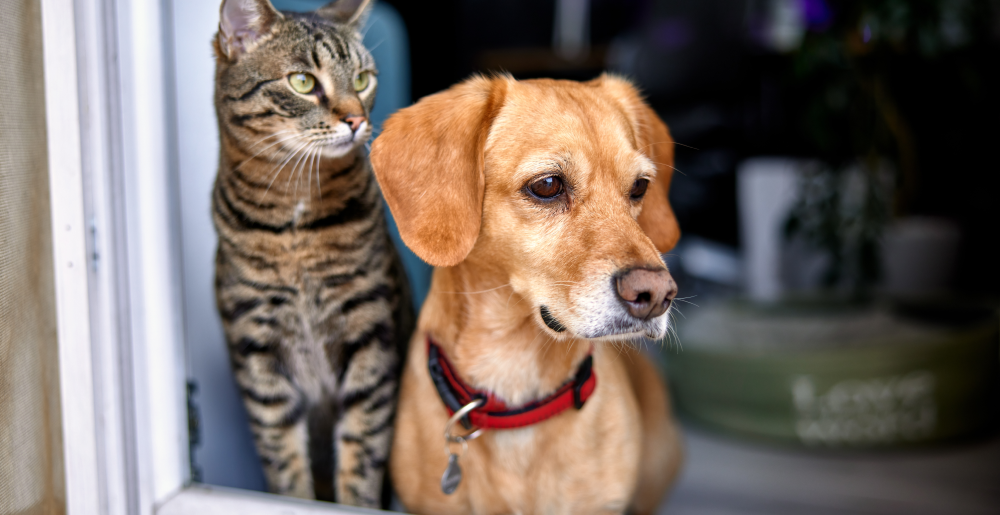
Coexistence of different animals always requires graduality and ability to listen. This applies to dogs, but also to different species sharing the same house. If you are interested to this topic, read our guide to life together for dogs and cats.
Each relationship has different timings. Our role is to create safe conditions for dogs to know each other, communicate and find their own balance. This too means nurturing Love, wellbeing, trust and a more peaceful life together, day by day.








 websolute