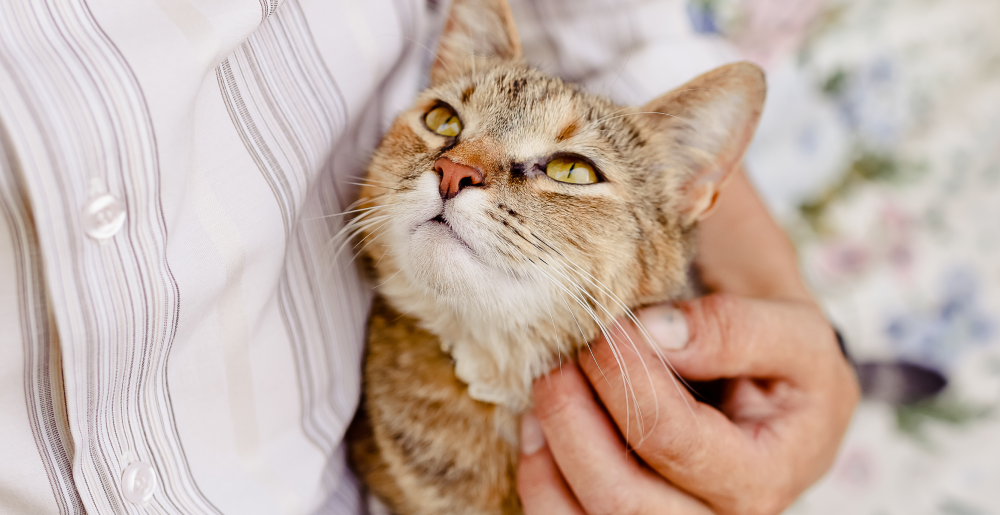


How do cats see us? Not just like human beings that enrich their daily love, but as a familiar presence they can distinguish, identify and in many cases also choose as a trusted companion.
Science can’t explain “who” we represent for our cats yet, but in the most recent years it has collected a great deal of information on the way our pets build a relationship with us.
Voice, smells, gestures, habits and even the way we squint our eyes contribute to making us recognizable to our pets. And then there’s their eyesight, of course: although a cat’s sight is rather different from ours.
In this article we’re going to discover how our cats see us and the world around them, what their looks mean and how to “be noticed” by our little feline friends with the help of some small gestures that can nurture their Love.
If we could get inside our cat’s mind for a few minutes, the first thing we’d want to know would be just this: how do they see their humans? Like completely different beings, like parenting figures, or like a sort of exaggerated-sized cat?
The most correct answer, for now at least, is less defined but maybe even more interesting: we don’t know in which “category” they have placed us.
However, we do know that they can distinguish “their humans” from all the others and can create a strong bond with those who take care of them, also through behaviors that are rooted in typical communication between cats.
The idea that cats might consider us as a sort of “non-hostile large cat” mostly comes from the theories of British ethologist John Bradshaw.
At the base of his hypothesis are some behaviors that cats have toward human beings that also belong to the interactions they have with each other, or to the relation between kittens and their mother: approaching us with their tail high, rubbing their head, licking our hair or kneading on us.
This doesn’t mean that it has been scientifically proven that cats consider us as their equals. This is just an interpretation based on feline behavior and it’s not a literal expression of their thoughts.
Those same gestures, however, could tell us a lot about the relationship our cat has built with us: in the article “Cats: six ways to show their love” we have taken a better look at some of these behaviours and the meaning they could have.
A study conducted in 2019 by Kristyn Vitale, Alexandra Behnke and Monique Udell from Oregon State University shifted the focus from hypothesis to experiments. We talked about this in the article "Cats and science: three studies to explain their behaviour”.
The researchers have taken a test that studies kids’ attachment styles and adapted it to cats, observing their behaviours during a short separation from their humans and during their reunion with them.
Among the 70 kittens that took part in the experiment, 64.3% showed a secure attachment style.
The percentage was higher among the 38 adult cats, rising to 65.8%. In these cases, the presence of their human worked as a sort of “secure base”: after their reunion, the cat balanced their time between seeking proximity and exploring the environment.
Talking about attachment styles can make us think about a parent-child relationship, especially because the test used in the study specifically comes from research on childhood attachment.
However, but to go from this to concluding that our cats considers us a parent is a leap that science doesn’t allow us to make.
What we can say is that many cats see the main person who takes care of them as a source of security, especially during a new situation (for example during visits with the vet).
This tells a lot about the relationship they can build with us, but it doesn’t explain what our image in their minds looks like.
In a nutshell: we know that they recognise us, and we are important to them. To know under what name they have saved us in their very personal mental categories, we still need to wait.
Cats can distinguish people, but not in the same way we do. In the feline world, some cues such as voice and smell play an important role. Regarding recognition of facial features, the information available is still limited. The result is a perception made of many details: the way we talk and the recurrent words, our smell, movements and what normally happens when we are present.
Sometimes you call them and they slightly move an ear. No running to you, no meowing. Are they really indifferent to you? Not necessarily.
In 2013, Atsuko Saito and Kazutaka Shinozuka have demonstrated experimentally that cats can distinguish the voice of the person they live with from that of strangers.
The response, however, consisted mostly of turning their head and ears towards the sound, much more than vocalizing or wagging their tail. In other words, recognition occurred even when the reaction seems almost imperceptible.
Another study conducted on 16 cats by Charlotte de Mouzon added a quite curious detail: cats could distinguish the tone of voice used by their owner when speaking specifically to them and the tone used with other adults.
When the same variation came from a stranger, on the other hand, cats couldn’t notice the difference.
So maybe that particular voice that you use for your cat doesn’t go unnoticed after all!
Smell is an important element in the way cats explore and distinguish what is familiar to them.
A study that was published in 2025 on Plos One magazine contributed very interestingly to what we already know about cat’s sense of smell.
During the experiment, cats showed more interest in the smell of a stranger compared to the smell of the person they lived with, lingering a little longer to smell it.
This behaviour suggests an ability to distinguish, through smell, a familiar person from a stranger. However, it’s still not clear if the smell alone can be enough to identify a specific person.
A name isn’t just a word we decided to give our cat. With time, it can become a recognizable sound.
In 2019, Atsuko Saito and some colleagues demonstrated that house cats can distinguish their own name from other words, even when a stranger pronounces it.
This doesn’t necessarily mean that they associate our same concept of identity to their name, but it indicates that they can recognize this sound and can distinguish it from other terms.
In 2022, another Japanese study that involved domestic cats and cats from Cat Cafés (explained in the article: “Cats and science: three studies to understand their behaviours”) showed even more curious results:
house cats seemed to be able to associate the name of other cats living with them to their image; while during the test dedicated to the human members of the family, a similar result emerged, also influenced by the number of people living at home and by how long they had been living together.
Here is where we have less certainties. Cats that recognize faces normally pair them with voice.
The 2022 japanese studies have observed that cats would stare longer at the screen when the voice they listened to didn’t match the face they were showed, meaning that they could notice the inconsistency. However, this also highlighted the fact that they use facial features only as a secondary signal, while voice and smell are still the primary cues.
It’s still early to conclude that cats can’t “recognize our face”. It would be more correct to say that visual recognition of faces is less well-documented compared to other aspects.
Cats can pick up on and put together some human emotional signals. Facial expressions, voices and behaviour can become information to observe, especially when they come from a known person.
An experiment conducted in 2015 by Isabella Merola and colleagues showed this in an unusual situation. When in front of an unknown object, 79% of the cats involved alternated their gaze from the object to their owner, as if they were looking for information from their reaction.
During the test, the people involved were asked to have a positive or negative reaction towards the object. The results showed that cats didn’t just pay attention to these cues, but also partially modified their behaviour based on the emotional reaction they received.
A year later, Moriah Galvan and Jennifer Vonk discovered a sensitivity to human emotional expressions that was slightly more visible when these cues came from a familiar person rather than a stranger.
So, what do cats think when they see us happy, nervous or angry? The experiments can’t explain this. However, they can suggest that our emotional state is not an irrelevant background: our cats observe us, collecting the cues that can be used to adjust their own behaviour.
Have you ever caught your cat’s eye and seen them slowly closing their eyes? This small movement has also attracted the attention of the scientific community.
In 2020, a study published on Scientific Reports analyzed the so called “slow blink”, the slow squinting of the eyes that we often see when we interact with cats.
When the owner slowly closed their eyes, cats tended to mimic the gesture. In a second experiment, they were more likely to approach the hand of a stranger after they had blinked slowly.
It’s a friendly gesture that is easy to try: instead of staring at a cat for a long time, especially if you are meeting for the first time, try and look at them gently, slowly squinting and then looking away.
A prolonged stare doesn’t always have the same meaning. A cat staring at you could also be waiting for something that they are associating with at that specific moment: a meal, a toy, the opening of a door or simply some attention.
To correctly interpret their language, you should also pay attention to their posture, their tail and most importantly to their ears’ position, that can give us plenty of information.
How do cats see us and the world around them? Not in black and white and not in a way that is comparable to our perception.
Their sight developed for different needs: less chromatic richness, a greater ability to take advantage of low lights and a particular sensitivity to movement.
To imagine how we can appear to their eyes we should give up our own sight, or at least a little bit.
Cats’ world isn’t a black and white movie. Cats can perceive colours but have a limited chromatic range.
Regarding the shades they can precisely perceive, available evidence suggests some shades of yellow and blue, while the differences between reds and greens seem to be less visible compared to human sight.
This also changes the way the objects we choose for them might appear in their eyes. Colours and contrasts work together, but what mostly attracts feline attention is movement.
They surely can see better than us, but they can’t see in total darkness. According to the Merck Veterinary Manual, in low light conditions, cats can see six times better than humans.
Their retinas contain a high concentration of rod cells, which are particularly sensitive and effective at capturing the little light available, while behind the retinas is the tapetum lucidum, a reflective layer that increases the light income and improves vision in the dark.
It is also what causes the typical glow in our cats’ eyes in pictures or at night.
A luminous source is still necessary: not even a cat could see in a pitch-black room, while they would be advantaged in dim light conditions. That’s why they can move around so easily in the dark hallway while we’re still looking for the light switch.
Feline vision isn’t as clear as ours. Veterinary sources describe cats as more short-sighted than humans: at the same distance, an object that is clearly visible to us can be blurry for them.
Cat’s sight system is more sensitive to movement, and this is a precious aspect for a predator. This is why, especially at a certain distance, shape and movement can be important cues for your cat to recognize you.
Their visual world is structured according to necessities that are different from ours. Just like a dog’s world, that we talked about in the article “How do dogs see? 4 things to know”.
To make your cat “notice” you more and become a familiar presence, you must build a relationship based on Love, that also means respecting their nature, paying attention to their needs and establishing an appropriate routine.
Knowing the way cats see and notice what surrounds them is also useful to notice when something changes.
If they suddenly seem to have trouble finding their way around familiar places, they bump into furniture or objects, appear unusually unstable in their movements and have constantly dilated pupils or reddened eyes, you must ask the advice of your veterinarian.
You won’t be able to determine the cause just by one behaviour, and it’s not helpful to try to diagnose the problem on your own.
Observing what’s different than usual, on the other hand, helps you collect precious information for the vet, to decide whether further controls are needed.
Yes. Studies show that cats recognize cues from familiar people, starting with their voice, and recent research indicates that they can distinguish a familiar person from a stranger from their smell. Saito and Shinozuka experiments showed that cats had the particular ability of recognizing their owner; while the face features remain a less-documented aspect.
We cannot say for certain. This idea is mostly linked to ethologist John Bradshaw’s interpretation: cats use several signals that belong to their language with us as well. This hypothesis is based on behavioural observation and it’s not the result of an experiment that proves that cats consider us as other cats.
Yes, meaning that they can distinguish it from other words, even when it’s a stranger pronouncing it. This was demonstrated by a study by Saito and colleagues that was published in 2019. You can learn more about this research and others in “Cats and science: three studies to explain their behaviour”.
No. Cats can see colors, but the chromatic range they’re able to perceive is not as wide as ours. Evidence shows that they can easily perceive blue and yellow shades, while others seem to be more difficult to distinguish.
It depends on the context. They could simply be observing you or waiting for something that’s part of their routine such as food, playing or some kind of interaction. To interpret their look, you should also observe the position of their ears, tail and posture. If that look appears punctually when it’s time to eat, in “How to make your cat happy at mealtime” you will find some advice to make that moment even more special.
Rather than imagining a mysterious “chosen one”, you can think of a relationship that you build over time. Cats develop their preference towards some people based on the experiences they share, on familiarity, on positive interactions and on predictability of their routines. Research on attachment also shows that many cats can regard their caregiver as a source of security.





 websolute